Key Takeaways
- Act of God vs. Negligence: Insurance covers “sudden and accidental” events but denies claims caused by lack of maintenance.
- Maintenance is a Requirement: Homeowners are contractually obligated to mitigate risks on their property.
- Warning Signs Matter: Visible decay, hollow trunks, and dead limbs are considered “pre-existing conditions” by adjusters.
- Documentation is Key: Professional inspections from a service like Challengers Tree Service provide a paper trail of care.
- Preventive Savings: The cost of professional pruning is significantly lower than a denied $20,000 roof repair claim.
When Insurance Won’t Pay: Understanding “Negligence” in Tree Damage Claims
For many homeowners in Columbus and Grove City, a heavy summer thunderstorm or a winter ice storm brings a familiar anxiety: “Is that tree going to hold up?” We often take comfort in our homeowners’ insurance policy, assuming that if a branch crashes through the garage or a trunk crushes the fence, the “Act of God” clause will kick in and cover the repairs.
However, there is a significant catch that catches many Central Ohio residents off guard. Insurance companies do not just look at what happened; they look at why it happened. If an adjuster determines that the tree fell because it was poorly maintained, diseased, or dead long before the storm arrived, they may deny your claim based on negligence. Understanding the line between an unavoidable accident and a preventable maintenance failure is essential for protecting your property and your finances.
The “Act of God” Myth vs. Reality
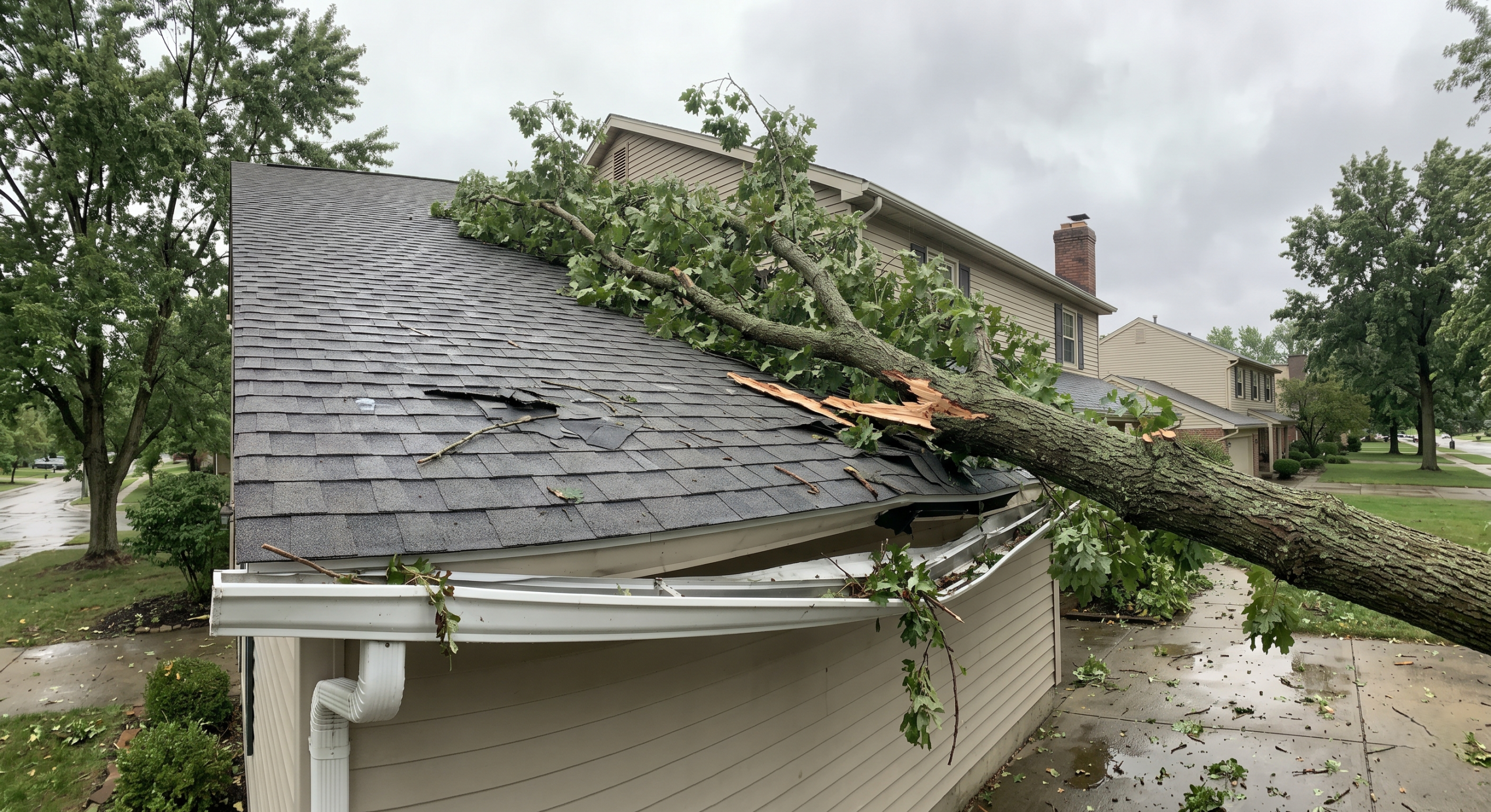
In insurance terms, an “Act of God” refers to a sudden, severe, and unpreventable natural event like a tornado, a lightning strike, or a freak microburst. If a healthy, vibrant oak tree is snapped in half by 80 mph winds and lands on your house, your insurance company will almost certainly pay for the damage and the removal of the tree.
But insurance is designed to cover accidents, not neglect. If that same tree had been dead for three years, riddled with termites, and leaning precariously toward your bedroom, the storm wasn’t the cause; it was merely the “final straw.” In this scenario, the insurance company views the damage as a result of your failure to maintain the property. They argue that you had ample time to identify the risk and mitigate it. When you sign a homeowners’ insurance contract, you are essentially agreeing to keep the property in a state of “good repair.” Ignoring a dying tree is considered a breach of that responsibility.
How Insurance Adjusters Define Negligence
When a claim is filed, an adjuster will inspect the stump and the fallen debris. They are trained to look for specific red flags that suggest the tree was a “ticking time bomb.” Common indicators of negligence include:
- Visible Decay and Rot: If the interior of the fallen wood is soft, pulpy, or hollow, it indicates long-term decay that should have been addressed. If an adjuster can stick a screwdriver six inches into the heartwood of the stump, they know the tree was structurally compromised years ago.
- Fungal Growth: Mushrooms or “conks” at the base of the tree are signs of root rot. Since these fungi take months or years to colonize a root system, an adjuster will argue that the homeowner is expected to have noticed and investigated them.
- Deadwood: If the fallen limbs have no bark, possess brittle “snap-prone” twigs, or show no signs of recent bud growth, they were dead long before the wind picked up.
- Previous “Notice”: This is the most dangerous scenario for a homeowner. If a neighbor sent you a certified letter or a city inspector issued a warning about the tree’s health, and you failed to act, your insurance company has a “slam dunk” case to deny your claim. They will argue the loss was “foreseeable.”
The Science of Tree Failure in Ohio
In Central Ohio, our weather patterns put unique stresses on trees. We experience heavy clay soils that can lead to root “heaving” during wet springs, followed by intense summer heat that bakes the ground and stresses the root systems. Species like the Silver Maple, which are common in older Grove City neighborhoods, are notorious for having “brittle” wood and developing multi-stemmed trunks that split easily.
Furthermore, the Emerald Ash Borer has left thousands of “zombie trees” across Columbus, standing dead Ash trees that look sturdy but are structurally hollow. Insurance companies are well aware of these regional issues. If an ash tree falls on your home in 2026, and you haven’t had it treated or inspected, the adjuster will likely label it a maintenance failure.
The High Cost of a Denied Claim
In the greater Columbus area, the financial fallout of a denied claim is twofold. First, you are responsible for the structural repairs to your home. With modern construction costs, a roof replacement or garage repair can easily exceed $15,000 to $30,000.
Second, you will have to pay the full cost of the tree removal. Most policies only cover tree removal costs (usually capped at $500–$1,000) if the tree hits a covered structure and the claim is approved. If the claim is denied due to negligence, you are responsible for every penny of the crane work, specialized equipment fees, and debris hauling. In an emergency storm situation, these costs are often premium-priced due to high demand.
Why “Wait and See” is a Risky Strategy
Many homeowners wait until a tree looks “really bad” before calling for an estimate. The problem is that trees often rot from the inside out. A tree can maintain a green canopy while the root system or the heartwood is 70% decayed. By the time the leaves start to turn brown, the tree may already be a significant liability.
By shifting to a proactive maintenance schedule, you aren’t just saving the tree; you are creating a legal and financial safety net. If you have a record of professional trimming and a “clean bill of health” from a reputable service, it becomes much harder for an insurance adjuster to claim you were negligent. You have demonstrated “due diligence,” which is the primary defense against a negligence charge.
The best way to ensure your insurance company pays out in the event of a disaster is to prove you were a responsible homeowner. This is where Challengers Tree Service comes in. Our team doesn’t just cut wood; we evaluate the health and structural integrity of your landscape.
By scheduling regular trimming & pruning and timely structural evaluations, you create a “paper trail” of maintenance. Professional pruning removes the “sail effect” of a tree, thinning the canopy so that high winds can pass through rather than pushing against the tree like a solid wall. This significantly reduces the leverage applied to the trunk and roots during Ohio’s frequent windstorms.
Keep Your Property Safe with Challengers Tree Service
Don’t wait for a storm to find out if your trees are a liability. At Challengers Tree Service, we specialize in identifying “high-risk” trees before they become “denied claims.” Whether you need a hazardous tree removal in Hilliard or routine tree trimming & pruning in Westerville, our team is available 24/7 to keep your home safe and compliant with insurance standards. We provide the professional documentation you need to show your insurance company that you take property maintenance seriously.
Frequently Asked Questions
1. Does insurance cover a tree falling on my car?
Usually, this falls under the “Comprehensive” portion of your auto insurance policy rather than your homeowners’ insurance. If a tree falls on your car while parked in your driveway, you file the claim with your car insurance provider.
2. What if my neighbor’s tree falls on my house?
In most cases, your own insurance will pay for the damage under your policy. However, if you can prove the neighbor was negligent, meaning you have proof, they knew the tree was dead (via written notice) your insurance company may “subrogate” or go after the neighbor’s insurance for reimbursement.
3. Will insurance pay to remove a tree that fell in my yard but didn’t hit anything?
Generally, no. Most policies only trigger coverage if a structure (house, fence, garage) is damaged. If it lands in an open field or your lawn, the cost of removal is typically the homeowner’s responsibility.
4. How can I tell if my tree is “neglected”?
Look for “V-shaped” trunk unions, deep cracks in the bark, soil heaving around the base, and large branches that lack leaves during the spring. If you see sawdust-like material (frass) at the base, it may indicate a terminal pest infestation.
5. Does homeowners’ insurance cover Emerald Ash Borer damage?
No. Insect infestations and the resulting death of a tree are considered a slow-moving maintenance issue, not a “sudden and accidental” event.
6. Can I get a discount on insurance for removing hazardous trees?
While not always a direct discount, removing hazards prevents claims. Since a single claim can cause your premiums to skyrocket or lead to policy non-renewal, preventative removal is a major long-term cost saver.
7. How often should I have my trees inspected?
We recommend a professional assessment every 2–3 years or after any major windstorm. Mature trees or species prone to failure should be checked annually.
8. Is “negligence” hard for insurance companies to prove?
Unfortunately, no. Arborists and adjusters can easily determine how long a tree has been dead by examining growth rings, the moisture content of the wood, and the presence of certain types of decay fungi.
Summary Checklist: When to Call for Removal
| Condition | Risk Level | Recommended Action |
|---|---|---|
| Hollow or soft heartwood | High | Schedule an immediate professional inspection to assess structural integrity and failure risk |
| Visible fungal conks or growth at the base | Moderate to High | Document the condition and request an arborist evaluation for root decay or structural weakness |
| Brittle deadwood | High | Remove hazardous dead limbs promptly to reduce breakage and falling branch hazards |
| Emerald Ash Borer infestation | High | Arrange urgent professional assessment to determine treatment options or safe removal needs |
| Written hazard notice from a neighbor or authority | Critical | Take immediate action to inspect and address the reported hazard condition |
Final Advice
If you notice any of these warning signs, do not wait for a storm to force the issue. A professional assessment from an arborist can determine if the tree can be saved through specialized care or if it must be removed to protect your property.