Key Takeaways:
- Sudden Change is Critical: A tree that tilts abruptly after a storm is an immediate emergency.
- Soil Indicators: Heaving soil or mounding at the base signifies root system failure.
- Species Vulnerability: Shallow-rooted species in Central Ohio clay are more prone to windthrow.
- Target Zones: Any leaning tree within striking distance of a structure or power line requires priority action.
- Expert Intervention: Professional rigging and removal are necessary to prevent property damage during failure.
In the neighborhoods of Columbus, Ohio, from the historic streets of German Village to the sprawling properties of Dublin and Grove City, trees are a vital part of our urban canopy. They provide shade during our humid summers and break the wind during our biting winters. However, the geography of Central Ohio presents unique challenges for tree stability. Our heavy clay soils, combined with high-velocity wind gusts and ice storms, can turn a majestic tree into a structural hazard in a matter of hours.
One of the most common concerns for Columbus homeowners is a leaning tree. While many trees grow with a natural tilt as they seek sunlight, there is a very fine line between a character lean and a catastrophic lean. Understanding when a leaning tree transitions from a landscape feature to a life-threatening emergency is essential for every property owner in the 614 area code.
Understanding Natural Lean vs. Hazardous Tilt
Before panic sets in, it is important to distinguish between a tree that has grown at an angle for decades and one that is actively failing.
The Seeking Lean
Trees are phototropic, meaning they grow toward the light. If a tree is shaded by a larger building or a dominant neighbor tree, it will naturally grow at an angle to reach the sun. You can usually identify a natural lean by looking at the trunk: the tree will often have a curved base or a sweep as it tries to correct its vertical growth. If the lean has been there for years and the ground around the base is undisturbed, it is likely not an emergency.
The Structural Tilt
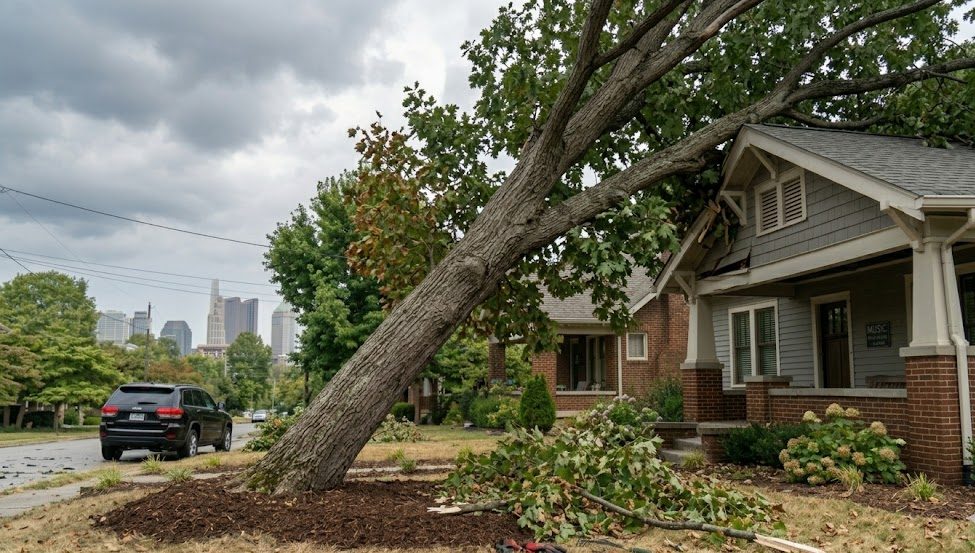
A structural tilt is an emergency. This occurs when the tree’s anchoring system, the roots, loses its grip on the earth. This is usually characterized by a straight trunk that is suddenly off-kilter. Unlike the natural seeking lean, a structural tilt usually happens abruptly, often following one of Columbus’s notorious spring thunderstorms or a heavy winter ice event that adds thousands of pounds of weight to the canopy.
Signs That Your Leaning Tree Is an Immediate Emergency
If you notice a tree leaning on your property, perform a quick visual audit using the following Emergency Indicators.
Heaving Soil and Root Exposure
Walk to the side of the tree opposite the lean. This is where the tension is highest. If you see the soil mounding up, cracking, or heaving, the root plate is physically pulling out of the ground. In Central Ohio’s clay-heavy soil, this often happens after heavy rain has lubricated the root zone. If you can see fine roots snapping or a gap between the trunk and the soil, the tree is in the process of falling.
The Target Assessment
An emergency is defined by the potential for damage. If a leaning tree is within striking distance of a home, a driveway, a sidewalk, or utility lines, its risk level is automatically Critical. In densely populated areas of Columbus, a falling tree rarely hits empty ground. If your leaning tree has a target, you cannot afford to wait.
Cracking Bark and Stress Fractures
Check the trunk for new cracks, especially near the crotch where major limbs meet. When a tree leans, the wood fibers on one side are compressed while the fibers on the other are stretched. If the bark is beginning to pop off or if deep vertical fissures are opening, the internal structure of the wood is failing under the stress of gravity.
Why Columbus Weather Intensifies Tree Risks
Central Ohio is situated in a region where weather extremes are the norm. Our trees have to contend with several factors that contribute to sudden leaning:
- Saturated Clay Soils: Clay holds water longer than sand. When the ground in Grove City or Westerville stays saturated for days, it becomes mushy, providing very little resistance to the leverage of a leaning tree.
- The Wind Tunnel Effect: Columbus’s flat topography allows wind to gain significant speed. A leaning tree that might stand in a forest will often fail in an open suburban yard where it lacks the windbreak of other trees.
- Ice Loading: In the winter, ice accumulation on a leaning tree creates an offset load. Since the tree is already off-center, the added weight of the ice acts as a lever, pulling the tree down with immense force.
The Danger of the Soft Lean
Sometimes a tree doesn’t lean all at once. It might lean an inch this week and another inch next month. This is known as a progressive failure. It is often caused by slow-acting root rot or the gradual decay of the heartwood. Homeowners should pick a fixed point, like the corner of a house or a fence post, to monitor the lean. If the gap between the tree and that fixed point is widening, the tree is an emergency waiting to happen.
Can a Leaning Tree Be Saved?
In some specific cases, a leaning tree can be stabilized using cabling and bracing. High-strength steel cables can be installed to anchor the tree to a more stable structure or to redistribute the weight of the canopy. However, this is usually only an option for trees with a minor lean and a healthy root system. Once the soil has heaved or the trunk has cracked, the structural integrity is gone, and the only safe course of action is professional removal.
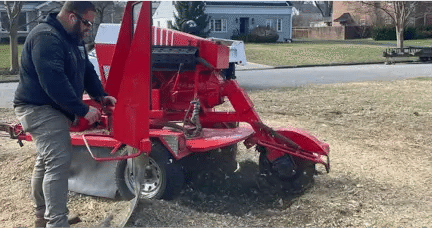
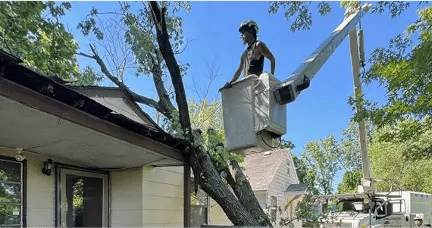
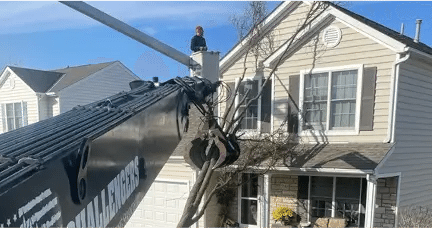
When a tree begins to lean precariously over your Columbus home or business, you need an expert team that can move faster than gravity. Challengers Tree Service is Central Ohio’s premier choice for 24/7 emergency tree care. While routine jobs may be booked out, we keep our emergency crews ready to respond immediately to hazardous leaks and storm damage in Columbus, Grove City, Hilliard, and the surrounding areas. Our licensed, insured, and safety-focused professionals utilize advanced equipment to perform precision removals, ensuring that even the most dangerously tilted trees are neutralized without damage to your property. With decades of hands-on experience and a 5-star reputation for quality and cleanliness, we handle everything from debris hauling to stump grinding. Don’t wait for the next gust of wind to turn a leaning tree into a catastrophe.
Frequently Asked Questions by Homeowners in Ohio
Is a leaning tree always an emergency?
No. Many trees have a natural lean. It becomes an emergency if the lean is new, if the soil is heaving, or if it threatens a target like your home or a power line.
What should I do if my neighbor’s tree is leaning toward my house in Ohio?
First, inform your neighbor of the hazard. In Ohio, if a tree is a known hazard and the owner fails to act, they may be liable for damages. It is best to have a professional arborist provide a written assessment.
Can heavy rain cause a tree to lean?
Absolutely. Heavy rain saturates the soil, reducing the friction that holds roots in place. This is the leading cause of leaning trees in the Columbus area during the spring.
How do I know if my tree is leaning more than it used to?
Look for stretch marks in the soil or fresh cracks in the bark. You can also hang a plumb bob (a weight on a string) to check the vertical alignment of the trunk against a fixed point.
Do insurance companies pay for leaning tree removal in Ohio?
Typically, insurance only pays for tree removal if the tree has already fallen and caused damage to a covered structure. However, it is always worth checking your specific policy regarding preventative hazard mitigation.
What are the most dangerous trees in Ohio for leaning?
Silver Maples and Bradford Pears are notorious for structural failure. Weeping Willows are also prone to leaning due to their affinity for wet, soft soil.
Is it safe to prop up a leaning tree with a board?
Never. A leaning mature tree weighs several tons. A wooden prop or a simple rope will not stop a failure and can create a false sense of security while putting you in the strike zone.
Does Challengers Tree Service work in Powell and Westerville, Ohio?
Yes. We serve the entire Central Ohio region, including Powell, Westerville, Gahanna, and Reynoldsburg, with 24/7 emergency response.
Summary Checklist: Leaning Tree Assessment
| Warning Sign | Risk Level | Recommended Action |
|---|---|---|
| Mounded or cracked soil at the base | Critical | Restrict access immediately and arrange emergency professional response due to possible root failure |
| New lean after a storm | High | Schedule urgent professional inspection to assess structural stability and root damage |
| Trunk cracks on the bend side | High | Clear the surrounding area and request immediate structural assessment for failure risk |
| Tree leaning over power lines | Critical | Stay clear and contact the utility provider plus qualified line-clearance professionals immediately |
| Natural sweep or curve in the trunk | Low | Continue routine monitoring during regular tree maintenance and seasonal inspections |
Final Advice
A leaning tree is a ticking clock. In the Columbus area, we are often just one heavy snowfall or one high-wind afternoon away from a hazard becoming a tragedy. The most important thing you can do as a homeowner is to stay out of the fall zone once you have identified the signs of an emergency. A tree that is pulling its roots out of the ground cannot be saved by amateur DIY methods.
Instead, document the situation with photos from a safe distance and contact a professional service that has the rigging expertise and heavy machinery to dismantle the tree safely. In Central Ohio, where property lines are often tight and houses are close together, dropping a leaning tree is rarely an option; it must be carefully pruned down by experts. By being proactive and recognizing the subtle shifts in your landscape, you can ensure that the trees on your property remain a source of beauty rather than a source of danger.