To understand risk, we must first understand the biology behind why trees lean. Most “crooked” trees are actually perfectly stable. They have adapted over the years to support their own weight by building “reaction wood” to reinforce the trunk.
Phototropism: The “Safe” Lean
Trees are phototropic, meaning they actively grow toward the strongest light source. If you have a tree planted near a shaded building or under the canopy of a larger neighbor, it will naturally curve to find the sun.
- Curved Trunk: The trunk sweeps or bows in a “J” or “L” shape.
- Self-Correction: The top of the tree (the leader) has corrected itself and is growing vertically straight up, even if the base is angled.
- Solid Anchor: The soil around the base is undisturbed, flat, and solid.
Root Plate Failure: The “Hazardous” Lean
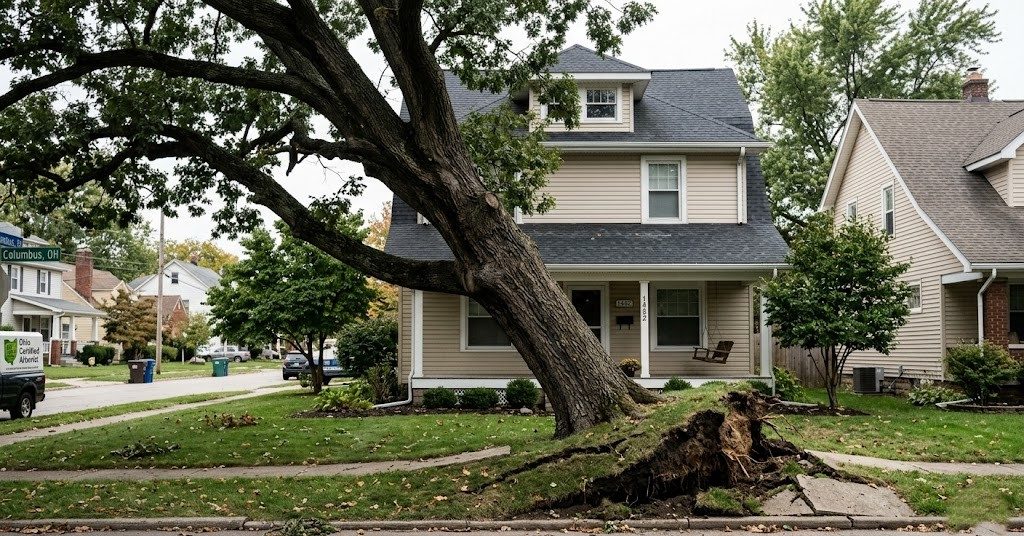
A dangerous lean usually involves the root plate, the disc of roots and soil that anchors the tree, rather than just the trunk shape. If the entire tree, including the base, is tipping, the root system is failing.
- Straight Trunk, Angled Stance: The tree looks like a telephone pole that is falling over; it is not curved, it is tilting.
- Recent Movement: The change happened suddenly after a storm, heavy rain, or construction work.
- Exposed Roots: You can see roots lifting out of the ground on the opposite side of the lean.
5 Critical Warning Signs of Imminent Tree Failure
If you suspect a tree is unstable, perform a visual inspection from a safe distance. Look for these five specific indicators that the tree’s structural failure is underway.
1. Soil Heaving (Root Plate Lifting)
This is the most alarming sign of immediate danger. Soil heaving occurs when the roots on the “uphill” side of the lean (the tension side) are being ripped out of the ground.
- What to look for: Cracks in the dirt, a mound of soil lifting near the base, or a distinct gap between the trunk and the earth.
- The Physics: Imagine pulling a tent stake out of the ground. As the tree tips, it pulls its anchor with it. If you see fresh earth or broken roots in this gap, the tree is actively falling; it is just moving very slowly.
2. Trunk Cracks and Buckling
When a tree leans, it experiences two massive forces: Tension (stretching) on the back side and Compression (squashing) on the leaning side.
- Horizontal Cracks: Usually found on the tension side. This indicates the wood fibers are snapping apart.
- Buckling Bark: Found on the compression side. The bark may look rippled, folded, or crushed, indicating the wood beneath is collapsing under the weight.
3. Sudden Exposure of Roots
Healthy roots should be firmly buried or resemble stable “fingers” gripping the surface. If you suddenly see fresh, pale roots that look like they were recently underground, or if the root bark is snapped and frayed, the anchorage system is compromised.
4. Changing Canopy Angles
Look at the very top of the tree. In a stable leaning tree, the branches will have grown to balance the weight. In an unstable tree, the canopy will look “wrong” or tilted.
- The “Plumb Bob” Test: Tie a rock to a string and hold it up at arm’s length, aligning it with the trunk. If the tree is leaning more than 15 degrees off-center and hasn’t corrected its growth, it is under immense stress.
5. Audible Noises
A tree that is in the process of failing often “talks.” If you hear loud cracking, popping, or creaking sounds coming from the trunk during a windstorm, it suggests that wood fibers are breaking. This is an emergency. Evacuate the area immediately.
Real Field Insight: The “Sleeping” Ash Tree
A Case from the Challengers Tree Service Job Log
Location: Grove City, OH. The Problem: A homeowner called us about a large Ash tree in their backyard. It had been dead for about three years (a victim of the Emerald Ash Borer), but stood straight. After a week of heavy spring rain and high winds, the homeowner noticed the tree was leaning slightly toward their garage.
Our Findings: When Joe, our owner, arrived for the assessment, he immediately noticed “mounding” on the back side of the tree; the soil was lifting about three inches. The dead roots had rotted away, and the rain had softened the clay soil so much that the remaining roots were sliding like a sled. The tree wasn’t just leaning; it was in the slow-motion process of uprooting.
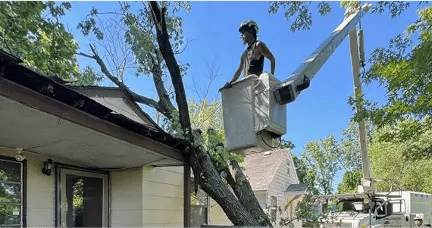
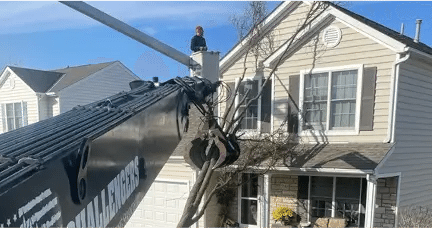
The Solution: Because the tree was too unstable to climb safely, we utilized a crane to dismantle the tree from the top down without putting a climber on the compromised trunk. We removed the hazard before the next storm could drop it on the garage.
Why Trees Lean: Common Causes in Central Ohio
Our local environment in Columbus and surrounding areas like Reynoldsburg, Hilliard, and Gahanna presents unique challenges for tree stability.
The “Clay Bowl” Effect
Much of Central Ohio sits on dense clay soil. While nutrient-rich, clay drains poorly. During our wet springs, the soil can become saturated. According to the Ohio State University Extension, this soil saturation reduces friction on the roots, leading to “windthrow,” where the entire root plate slides or tips over.
Construction Damage
Have you recently installed a driveway, patio, or underground utility line? Cutting major structural roots (even 10-15 feet away from the trunk) can destabilize a tree. Often, the tree won’t lean immediately but will begin to shift months later as the remaining roots decay.
Frequently Asked Questions About Leaning Trees
Can a leaning tree be saved or straightened?
In most cases, for mature trees, no. Once a large tree has shifted its root plate (soil heaving), the roots have been severed or detached. You cannot simply push it back up and expect the roots to reattach. Small, young trees (newly planted) can sometimes be staked and corrected, but a mature oak or maple with a new lean generally requires removal. To understand more about the structural limits of leaning trees, the USDA Forest Service provides comprehensive hazard tree guidelines that arborists use to determine stability.
Is the city responsible for a leaning tree near the street?
This depends on your specific municipality (e.g., Columbus vs. Grove City vs. Upper Arlington). Generally, if the tree is in the “tree lawn” (between the sidewalk and street), it may be city property. However, if the trunk is on your side of the sidewalk, it is likely your responsibility. We recommend checking your local city ordinances.
Will my homeowner’s insurance cover tree removal?
Typically, insurance policies cover damage caused by a fallen tree, but they do not cover the preventative removal of a leaning tree. However, if the tree is an imminent hazard, some policies might have exceptions or specific clauses. Documenting the hazard with a professional invoice from a tree service can sometimes help demonstrate that you took proactive steps.
What is “Windthrow”?
Windthrow is the technical term for a tree being uprooted by wind. It is distinct from “stem failure” (where the trunk snaps). Windthrow is very common in Ohio’s shallow, wet soils. For more information on identifying these risks after storms, the University of Minnesota Extension offers clear advice on when to intervene.
Does ivy cause trees to lean?
Indirectly, yes. A heavy infestation of English Ivy adds significant weight to the canopy and increases “wind sail” (wind resistance). This extra drag can pull a tree over during a storm. Additionally, ivy traps moisture against the bark, potentially hiding or accelerating decay.
About the Author The Challengers Tree Service Team has been serving Central Ohio for over years. Led by owner Joe, our crew specializes in hazardous tree removal and storm damage mitigation. We prioritize safety and education, helping our neighbors in Columbus and Grove City make informed decisions about their landscape.